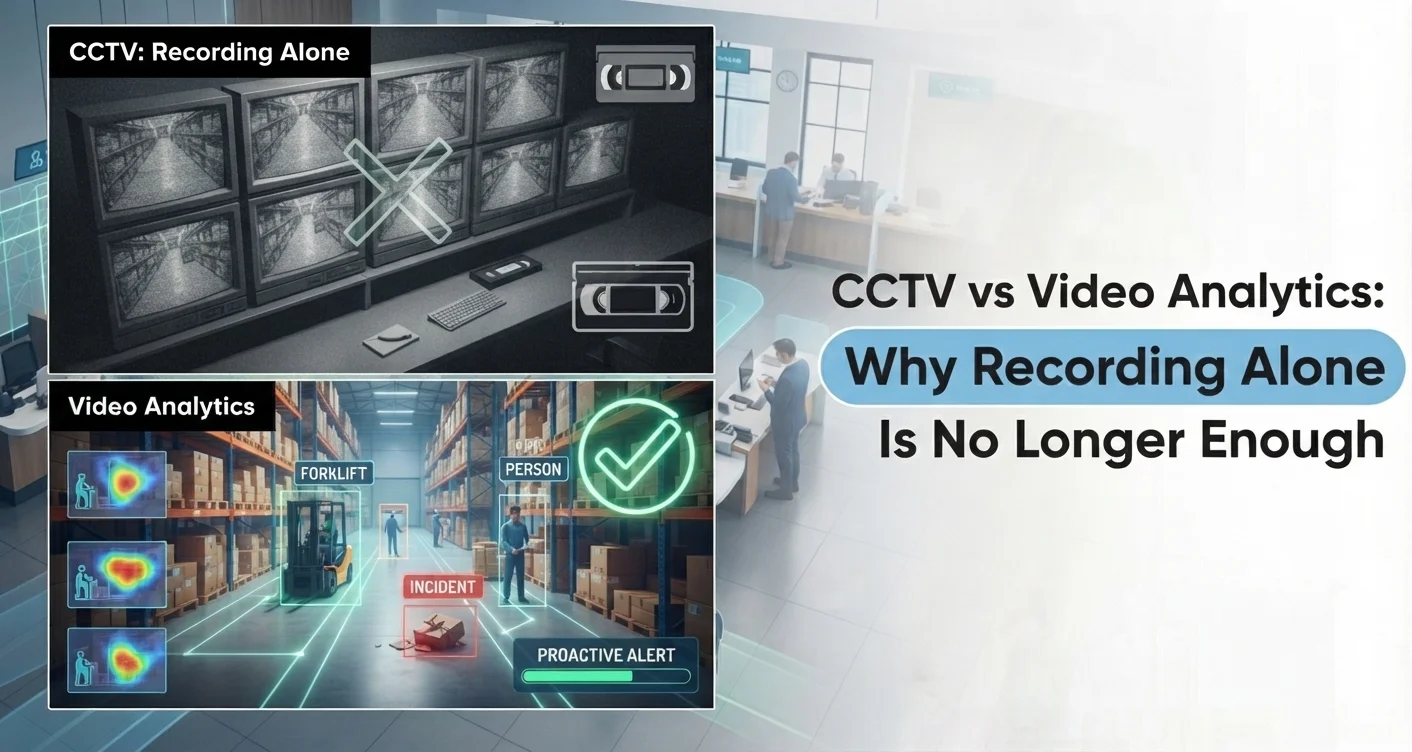
Across Egypt, businesses are recording more footage than at any point in the past. Branches in Cairo, malls in New Cairo and Sheikh Zayed, factories in the industrial zones of 6th of October and 10th of Ramadan, bank halls in Alexandria — all covered by cameras that never stop writing to storage. The question is no longer whether you record. The question is what those recordings do for your business while the day is still running.
Recording Is Storage, Not Protection
A camera that only records is a witness, not a guard. It documents what went wrong after the loss is already realized and after the customer has already left. In most organizations the footage is opened only when a problem is reported, which means the entire value of the system depends on someone noticing the problem in the first place.
The result is familiar to every operations manager in the Egyptian market: checkout points left without a cashier and discovered hours later, hygiene breaches that surface only during an inspection, trucks waiting unrecorded at loading docks, and queues that grow long enough for customers to simply walk out — all captured perfectly on video that nobody had the time to watch.
CCTV vs Video Analytics: The Difference in Practice
The gap between a recording system and an active analytics layer is not about hardware. It is operational. One produces evidence for investigations. The other produces action while the event is still unfolding.
| The situation | Recording only | Recording + analytics |
|---|---|---|
| Checkout point left unattended | Discovered during shift review | Alert within seconds of the last cashier leaving |
| Kitchen staff without a hairnet | Surfaces during inspection | Alert at the moment of entry |
| Truck at the loading zone | Manual log, if any | Automatic entry and exit record |
| Customer queue building up | Noticed when a complaint arrives | Alert when the wait crosses your threshold |
| Visitor traffic for the branch | Rough estimate | Exact counts, separated from staff movement |
| After an incident | Hours of footage searching | The relevant clip arrives attached to the alert |
Every line in that table maps to a cost your business is already paying — in shrinkage, in staffing hours, in lost customers, and in compliance exposure.
The Cost You Are Already Paying
Recording-only CCTV carries three silent costs. The first is staffing: someone must watch, and human attention collapses after minutes of passive screen monitoring. The second is latency: every issue is handled after the fact, when the cost of fixing it has already multiplied. The third is blindness: the recordings contain patterns — footfall, dwell time, conversion, compliance — that never reach the people making decisions about layout, staffing and expansion.
What This Means for Businesses in Egypt
The Egyptian market is moving faster than its monitoring habits. Retail chains are expanding across governorates, food brands are multiplying branches, banks are competing on customer experience, and industrial facilities are scaling output — while supervision still depends on shift supervisors walking the floor and guards watching wall after wall of live screens.
- Retail: shrinkage, staff discipline and opening hours compliance are no longer manageable by walkthroughs across tens of branches.
- Food and beverage: National Food Safety Authority oversight makes a missed hairnet or mask an inspection risk, not an internal note.
- Banking: branch performance is measured in waiting minutes; a queue that resolves itself silently still costs satisfaction scores.
- Manufacturing and logistics: safety zones around heavy equipment and truck turnaround times demand records, not memory.
Local Presence Is Not an Option — It Is the Model
This is where the difference between a remote vendor and a local partner shows. ARMANET works from inside the Egyptian market: deployment, configuration, training and support are handled by teams on the ground, working in Arabic and English, across Cairo, Alexandria and the Delta. Our strategic partnerships with Vodafone and Etisalat Misr tie deployments to the connectivity backbone that Egyptian operations actually run on.
And the layer runs on the cameras you already own. No rip-and-replace, no operational pause — the first dashboards and alerts go live within days of starting.
An alert that arrives after the shift ends is a report. An alert that arrives while the customer is still at the door is a decision. That is the entire difference.
Where to Start
We have already covered how existing cameras become a source of business intelligence in From CCTV to Business Intelligence, and how identity and access layers scale across enterprises in our enterprise face recognition guide. For a direct look at how your own camera network behaves under an analytics layer — on your floor, with your team — book a session with our team in Egypt.
Book a demo with ARMANET and see the difference between recording and acting, measured on your own cameras.