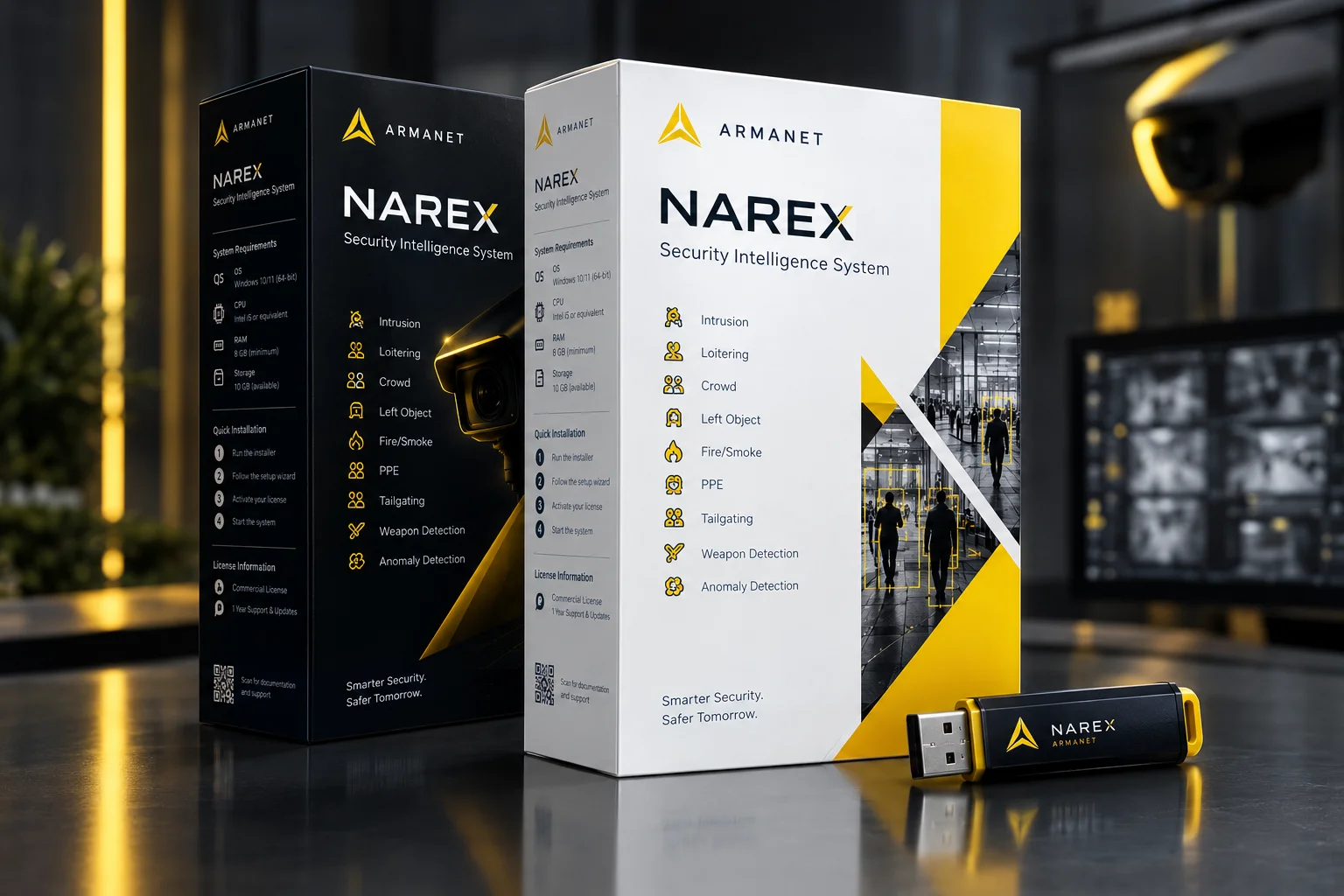
NAREX is the ARMANET security intelligence system — a real-time AI layer that watches every frame from every camera on your network and acts the moment something is wrong. Not after. Not during review. The moment.
Traditional surveillance is a witness. It records what happened and waits for someone to ask. NAREX is a guard. It identifies threats while they are forming — an intruder climbing the fence, a fire starting in a storage room, a weapon appearing at an entrance, a crowd building beyond safe density — and it alerts the right person before the situation becomes an incident.
From Reactive to Proactive
Most security operations follow the same pattern: an incident occurs, someone reviews footage, a report is written, and nothing changes until the next incident. NAREX reverses this. The system detects in real time, alerts in real time, and documents automatically — producing the audit trail before the investigation begins.
The result: response times measured in seconds, not hours. Damage prevented, not just recorded. And a security team that spends its time responding to events instead of searching for them.
Intrusion Detection
Define virtual perimeters on any camera view — fences, walls, doorways, restricted zones. NAREX monitors these boundaries continuously. When a person or vehicle crosses into a protected area outside permitted hours or without authorization, the system triggers an instant alert with the exact camera, the exact zone, the exact timestamp, and a capture image of the intruder.
Zones are configurable independently. The loading dock requires vehicle access from 8 AM to 6 PM and human access only from 6 PM to 8 AM. The server room requires biometric authentication at all times. The perimeter fence requires nobody at any time. Each rule is set per zone, per schedule, per camera.
Loitering Detection
A person standing outside a bank vault door for 3 minutes is suspicious. The same person walking past it in 10 seconds is normal. NAREX distinguishes between the two. The system tracks how long any person remains within a defined zone and triggers an alert when the duration exceeds a configurable threshold — 30 seconds, 5 minutes, or any period that matches the risk profile of that zone.
For retail, this catches professional thieves who case the store before acting. For banks, it identifies individuals waiting near ATMs or vault access points. For industrial facilities, it detects unauthorized personnel lingering near critical equipment.
Crowd Monitoring
When the number of people in a zone exceeds a defined threshold, NAREX alerts facility management. For event venues, this prevents dangerous overcrowding before it becomes a stampede. For malls, it triggers additional staffing during unexpected surges. For factories, it flags unusual gatherings that may indicate work stoppage or safety concerns.
The system tracks not just headcount but density — how tightly packed a crowd is becoming — and flow patterns — whether movement is orderly or chaotic. This enables early intervention before a crowd situation becomes a management crisis.
Fire and Smoke Detection
Visual fire and smoke detection on existing cameras. No dedicated thermal sensors required. NAREX analyzes the visual signatures of smoke plumes and flame patterns in real time, detecting fire in its earliest stages — before heat sensors trigger, before sprinklers activate, before the fire spreads beyond its origin.
The system distinguishes between actual smoke and environmental false positives: steam, fog, dust, reflections. When a genuine signature is confirmed, the alert includes the camera location, the zone, and a capture image — giving the response team visual confirmation before they commit resources.
Left Object Detection
An unattended bag in a mall corridor. A briefcase left under a bank counter. A box placed near a government building entrance. NAREX detects any object that appears in a monitored zone and remains stationary beyond a configurable duration. The alert specifies the exact location, the time the object appeared, and a capture image showing the item and its surroundings.
For high-security environments — airports, embassies, stadiums — the threshold can be set to as low as 10 seconds. For commercial spaces, a longer duration reduces false positives while still catching genuine threats.
Tailgating Detection
One person badges through a secure door. Two people enter. This is tailgating — and it is the single most common access control violation in corporate and government facilities. NAREX counts the number of people passing through a controlled access point and compares it to the number of authentication events. A mismatch triggers an instant alert with capture images of everyone who entered.
Integrated with ArmaFace, the system identifies each person who tailgated — converting an anonymous violation into a documented security event with a name, a face, and a timestamp.
Weapon Detection
NAREX identifies visible weapons in camera view: handguns, long guns, knives, and blunt weapons. When a weapon signature is detected, the system triggers the highest-priority alert — sent to security personnel, facility management, and optionally directly to law enforcement liaison channels.
The alert includes the camera, the zone, the timestamp, and a full-resolution capture of the individual holding the weapon. For schools, government buildings, and banks, this capability is not a feature — it is a requirement.
PPE Compliance
For factories, construction sites, and industrial facilities, NAREX monitors whether workers are wearing required protective equipment: helmets, safety vests, masks, gloves, goggles, and safety boots. The system checks at zone entry points and continuously within designated zones. When a worker enters a PPE-required area without proper equipment, an alert is sent to the zone supervisor with a capture image showing the specific violation.
Compliance rates are logged per shift, per zone, and per team — producing an inspection-ready record in Arabic that satisfies labor inspectorate requirements without manual compilation.
Anomaly Detection
NAREX learns what is normal for each monitored environment — the typical flow of people, the usual vehicle patterns, the expected activity levels per hour and per day. When something deviates significantly from this learned baseline, the system flags it.
This catches threats that rule-based systems miss: a person moving through a facility in an unusual pattern, a vehicle parked in an unexpected location, activity during hours when the facility should be empty. Anomaly detection is the safety net that catches what the specific rules do not.
Every Alert in Arabic
This is where NAREX separates from every international platform operating in this market. An alert that says Intrusion Detected Zone 3 is information. An alert that says a person is climbing the fence in Zone 3 near the loading dock entrance is intelligence. NAREX generates alerts in Arabic — describing what the system saw, where it happened, and what the response team needs to know. Not a translated label. A described event.
For Arabic-speaking security teams, this is the difference between reading an alert and understanding it instantly. For incident reporting, this is the difference between manual documentation and automatic Arabic-language records that satisfy compliance requirements.
On-Premise Architecture
Security footage is among the most sensitive data an organization holds. NAREX processes every frame on local infrastructure — inside the facility network, on-premise, with zero cloud dependency. No security function requires internet connectivity. No alert, no capture, and no detection data crosses the network boundary.
For government, military, diplomatic, and financial installations where data sovereignty is a hard requirement — not a preference — this is the architecture that passes review.
Part of the ARMANET Platform
NAREX does not work alone. When an intrusion is detected, the system can trigger ArmaFace to identify the intruder from the watchlist, and ARVORA to track their vehicle across the parking network. When a fire is detected, the system can alert emergency teams while simultaneously documenting the evacuation flow through crowd monitoring. Every NAREX event feeds the same Arabic-language dashboard that runs the entire ARMANET ecosystem — one platform, one interface, one source of truth.
Who It Is For
- Government and diplomatic facilities: Intrusion, weapon detection, tailgating, anomaly — the full security stack on existing cameras.
- Banks and financial institutions: Weapon detection at entrances, left object near vaults, loitering at ATMs, after-hours intrusion.
- Factories and industrial zones: PPE compliance, fire and smoke, perimeter intrusion, danger-zone access violations.
- Schools and universities: Weapon detection, unauthorized entry, crowd monitoring during events, left object in corridors.
- Malls and commercial centers: Left object, crowd density, after-hours intrusion, anomaly in parking areas.
- Hospitals and healthcare: Fire and smoke, access to restricted zones, crowd in emergency departments.
The Local Advantage
International security platforms operating in this market process frames on foreign servers, generate alerts in foreign languages, and deploy models trained on foreign environments. NAREX eliminates all three. Every detection model is maintained locally. Every alert is generated in Arabic. Every capture stays inside the facility network. Support is from Cairo — an engineer who has stood in an Egyptian factory, not a ticket queue in another timezone.
Security is not a product that ships in a box. It is a system that lives where the threats live — here, in this market, in these conditions, in this language.