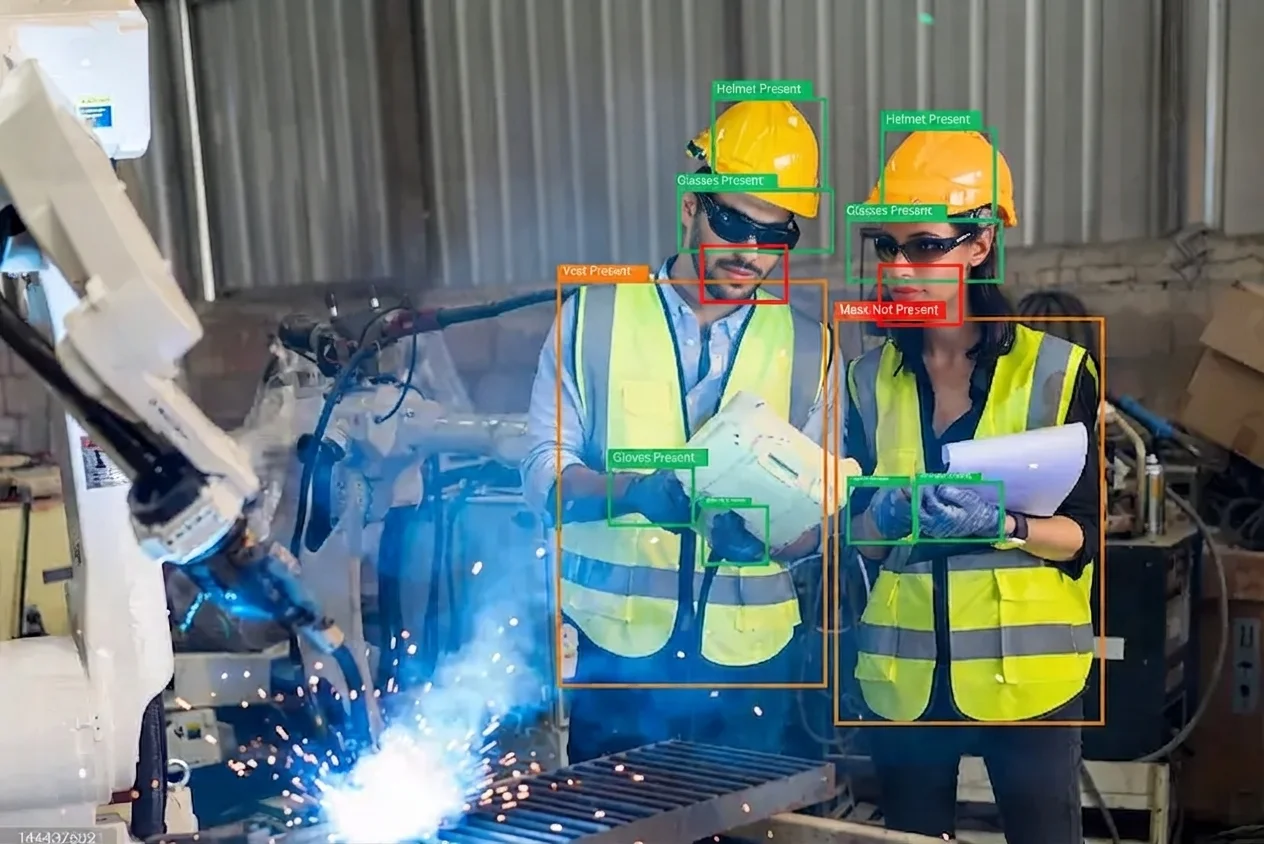
Industrial facilities across Egypt operate under a binding legal duty: the employer provides protective equipment, and the labor directorate enforces compliance through scheduled and unannounced inspection. Between the written policy and the operational floor, however, stands a structural gap — the percentage of working hours actually observed by any human eye. It is this gap, not the policy, that determines the real safety level of a facility.
The production floors of the 10th of Ramadan, 6th of October, Sadat City and Borg El Arab industrial zones are already covered by camera networks recording every zone continuously. Real-time PPE compliance monitoring converts that existing footage into an active safety layer: every entry into a designated zone is checked against the required equipment for that zone, and the responsible supervisor receives an alert at the moment of violation — not in a report after the shift ends.
Compliance Is a Coverage Question, Not a Policy Question
The failure point of every PPE program is arithmetic, not intent. A facility operating continuous shifts with rotating crews and contractor teams cannot achieve observational coverage through supervision staffing alone.
| The element | Typical large facility |
|---|---|
| Workers per shift | 200+ |
| Safety officers on the floor | 1 to 2 |
| Production zones requiring distinct PPE rules | 5 to 8 |
| Continuous supervision coverage per zone | Not attainable with staffing alone |
| Camera coverage of the same zones | Already installed and recording |
The conclusion is structural: the facility is already fully observed by its own infrastructure. What is missing is the conversion of recording into enforcement — the same operational gap we established in CCTV vs Video Analytics, which on a production floor ceases to be an efficiency question and becomes a safety liability.
The Cost Structure of a Single Work Injury
Work injury economics follow an iceberg pattern: the visible component — treatment and compensation — represents the smaller share of the total. The remainder is absorbed across production, administration and compliance lines without ever appearing as a single cost item.
| The cost | Where it lands |
|---|---|
| Treatment and compensation | Insurance — visible, budgeted |
| Line stoppage at the moment of injury | Minutes to hours of lost production |
| Internal investigation and reporting | Days of administrative capacity |
| Temporary replacement and training | A week of output from one position |
| Premium adjustment the following year | Recurring, not one-time |
| Inspection attention after the incident | Unannounced and open-ended |
Prevention economics operate in the opposite direction. The cost of detecting a missing helmet at the moment of zone entry is a fraction of any single line in the table above — and it eliminates the root cause of every row that follows.
Where Egyptian Industry Carries the Highest Exposure
Four structural conditions define the exposure of Egyptian manufacturing facilities.
- Night shifts: supervision density is lowest during the hours machinery operates at full capacity — the weakest observational coverage guarding identical risk levels.
- Contractor and maintenance crews: teams operating outside the permanent roster, rotating between sites, and carrying site-specific rules they are least equipped to absorb.
- Zone-based rule variance: loading areas, press zones, chemical storage and warehousing each enforce distinct equipment requirements — a single walkthrough cannot verify rules that differ zone by zone.
- Post-incident scrutiny: after any recorded incident, inspection intensity rises while the facility operates under elevated compliance pressure for an extended period.
What Changes on Day One
Converting the camera network into a compliance layer produces four immediate operational shifts — none of which requires new hardware at the production line.
- Alerts at the moment of violation: the alert reaches the zone supervisor while the violation is still in progress, converting response time from hours to seconds.
- Compliance records by zone, shift and team: the facility holds a continuous, timestamped record of equipment compliance — ready for inspection at any moment, in Arabic, without preparation time.
- Workforce separation by design: monitoring covers those present in the zone — permanent and contractor staff alike — with the same discipline applied to separating workers from visitors that we established in measuring the true cost of attendance fraud.
- Trend reporting at management level: compliance rates per shift and per zone surface the exact locations where reinforcement, training or physical layout changes are required.
Local Delivery Inside the Industrial Zones
Industrial safety programs succeed or fail at the configuration layer: zone definitions, equipment rule mapping, shift structures and Arabic reporting. This is operational work that cannot be delivered remotely — it requires a team present in the facilities, working in the language of the floor. ARMANET operates from inside the Egyptian market, with deployment and support teams across Cairo, Alexandria and the Delta, and strategic partnerships with Vodafone and Etisalat Misr covering the connectivity backbone of industrial operations.
The layer runs on the camera network the facility already owns. No production stoppage, no additional hardware at the machinery, no construction work — first alerts and compliance dashboards go live within days of project start.
Safety budgets purchase equipment. The exposure they cannot cover is the interval during which that equipment is absent. Monitoring closes that interval — and only monitoring closes it.
Where to Start
The entry point is one high-risk zone: one camera view, one set of equipment rules, one shift cycle. Within a single session, the ARMANET team in Egypt demonstrates the compliance rate that zone is producing today — and the alert flow it produces from the first day of operation.
Book a demo with ARMANET and put the safety policy on measured, enforced ground.