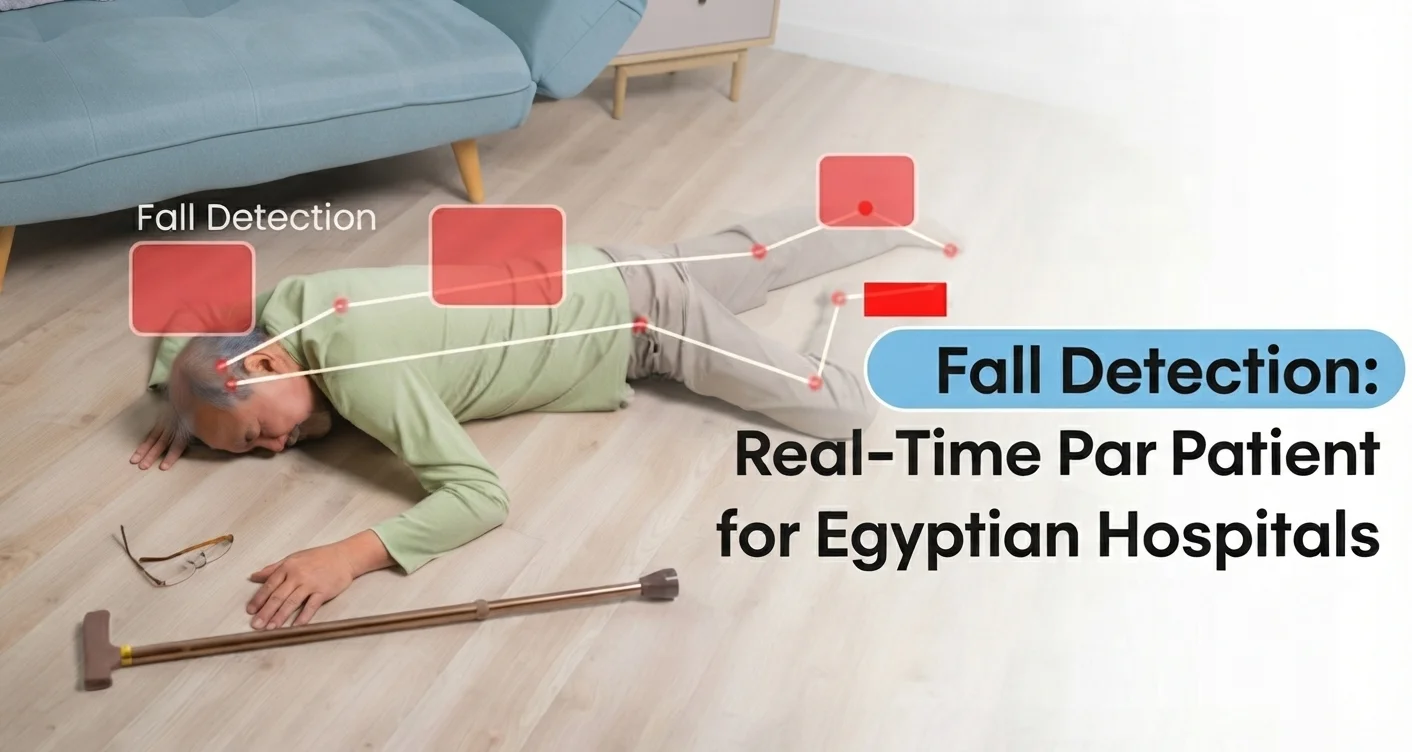
Hospital falls are among the most documented incidents in clinical governance worldwide — and among the least prevented. The Egyptian healthcare sector is expanding capacity across Cairo, Alexandria and the governorates while operating under the same structural reality: patients at elevated fall risk are distributed across wards and corridors, and the detection of a fall depends, in most facilities today, on the fall being seen or heard.
That dependency is the exposure. A patient who falls in a corridor during a low-staffing window, or in a room during rounds elsewhere, may remain on the floor until the next scheduled check. Clinical literature is unambiguous about the consequences: response time is the single strongest variable in the severity of outcomes following a fall. The camera networks already installed across hospital corridors and wards convert that dependency into an active detection layer — alerting the assigned nursing team at the moment a fall occurs, with the location marked.
Where Hospitals Carry the Exposure
Every fall incident opens four cost lines simultaneously — clinical, legal, administrative and reputational — and each escalates with response time.
| The exposure | How it escalates |
|---|---|
| Clinical outcome severity | Directly proportional to time on the floor before response |
| Incident documentation and investigation | Falls unwitnessed require reconstruction — the longest investigations |
| Liability exposure | Documentation gaps convert incident reviews into liability reviews |
| Insurance and accreditation positioning | Fall statistics feed premium and accreditation files |
| Family and community trust | How a hospital responds to one incident defines its reputation |
The unwitnessed fall is the worst case in every row of the table — and it is precisely the case continuous detection eliminates.
The Staffing Arithmetic of Fall Response
Nursing ratios in Egyptian hospitals are under continuous pressure. The coverage model that assumes a nurse observes every assigned patient simultaneously does not survive contact with reality — one team covers rooms, corridors and service areas in parallel, and the interval between scheduled patient checks is measured in tens of minutes.
| The coverage model | What it produces |
|---|---|
| Scheduled rounding only | Detection waits for the next round — tens of minutes |
| Nurse call buttons | Depends on the patient being conscious, mobile and able to reach the button |
| Continuous camera detection | Alert at the moment of the fall — seconds, with location attached |
The gap between the first two rows and the third is not a staffing failure — it is an infrastructure question. The cameras covering corridors and wards are already installed; converting their recording into real-time alerts is the operational shift we established across our deployments in CCTV vs Video Analytics — applied here to the highest-stakes environment a facility operates.
What Changes on Day One
Deploying fall detection on the existing camera network produces four immediate operational shifts for the hospital.
- Alerts with location, at the moment of the fall: the assigned nursing team receives the alert with the exact ward and position — response time collapses from minutes to seconds.
- Every fall becomes witnessed: the detection event carries its own timestamped record — incident documentation is complete at the moment it is created, not reconstructed afterwards.
- High-risk patient coverage without dedicated staffing: wards define elevated-risk areas within the existing camera map; monitoring applies additional attention where the clinical profile requires it.
- Management-level trend data: fall events aggregated by ward, shift and time window direct preventive investment to the exact locations producing incidents.
Two Sectors, One Discipline
Fall detection belongs to the same operational family as the compliance monitoring we detailed in hygiene compliance automation in food service: the camera network already observes the environment — the monitoring layer converts observation into an enforceable, documented, real-time response. Hospitals apply the identical architecture to a higher-stakes event class, with the same deployment discipline our industrial clients apply to PPE compliance on production floors.
Local Delivery for the Healthcare Sector
Healthcare deployments succeed on configuration and clinical integration: ward mapping, escalation routing to the correct nursing station, Arabic reporting for incident files, and coordination with existing hospital administration systems. This is not remotely deliverable work. ARMANET operates from inside the Egyptian market, with deployment and support teams across Cairo, Alexandria and the Delta, and strategic partnerships with Vodafone and Etisalat Misr covering the connectivity backbone of hospital operations.
The layer runs on the camera network the hospital already operates in corridors and wards. No construction, no additional bedside hardware, no disruption to clinical operations — first alerts route to nursing teams within days of project start.
Fall response has always been a question of luck — who happened to be passing. Continuous detection removes luck from the clinical equation, and replaces it with a timestamped alert and a response team in motion.
Where to Start
The entry point is one ward: the existing camera views, the assigned nursing escalation path, and one week of operation. Within a single session, the ARMANET team in Egypt demonstrates the detection layer running on that ward — and the alert flow the nursing team will receive from the first day.
Book a demo with ARMANET and put patient fall response on measured, second-level ground.